HOME / WORK / BANKING GOALS
CASE_STUDY // FINANCIAL_UX

DRIVING 30% GROWTH
IN ACTIVE SAVINGS GOALS

Redesigning a banking app's goal-setting experience to increase adoption, improve 90-day retention, and reduce support friction—without gamification.

// ROLE UX DESIGNER
// TIMELINE 2 WEEKS
// PLATFORM MOBILE APP
// STATUS PROTOTYPE
01 // CHALLENGE

The Challenge

A digital bank needed to increase savings goal adoption by 30% and improve 90-day retention among goal users. The existing experience was failing: users faced an 8–12 step flow filled with financial jargon, unclear account selection, and zero real-time feedback. 40% abandoned before completion.

The existing goal-setting experience created multiple friction points that prevented users from completing setup:

  • 8–12 step flows overwhelmed users
  • Financial jargon created confusion
  • No real-time feedback on feasibility
  • Unclear account selection led to errors
  • 40% abandonment rate before completion
  • No gamification—no badges, points, or rewards
  • Goals must link to existing accounts
  • Must work within current app infrastructure
  • 30% increase in active savings goals
  • Improved 90-day retention for goal users
  • 20% reduction in support tickets
  • Flow completion rate >70%
  • Time to completion <60 seconds
02 // RESEARCH

Research Insights

Three key findings shaped the design direction

🎯

Users Prioritize Tangibility Over Timeline

People fund goals they can feel ("Trip to Japan") 4x faster than abstract obligations ("Emergency Fund")—not because of timeline, but emotional connection.
// SOLUTION

Rather than forcing users into abstract categories, we let them choose personal, tangible names. For abstract goals users DO create (like emergency funds), dynamic milestone messages adapt to goal type—making progress feel concrete:

  • Vacation goals: "That's like booking your flight ✈️"
  • Emergency funds: "That's 2 weeks of expenses covered"
  • Home/car goals: "You're 30% toward your down payment"

This approach respects user choice while ensuring even abstract goals feel tangible through contextual progress feedback.

Friction Points Kill Momentum

Competitive analysis revealed consistent patterns across banking goal-setting flows that cause user drop-off:
  • 8–12 step flows create decision fatigue
  • Account numbers without names/balances lead to errors
  • No real-time feedback prevents feasibility assessment
  • Financial jargon creates cognitive load
PATTERN  Every unnecessary decision point increases drop-off exponentially.
// SOLUTION

Our design systematically eliminates friction:

  • 4 steps vs. industry 8–12 (60% reduction)
  • Plain language throughout
  • Real-time monthly calculation
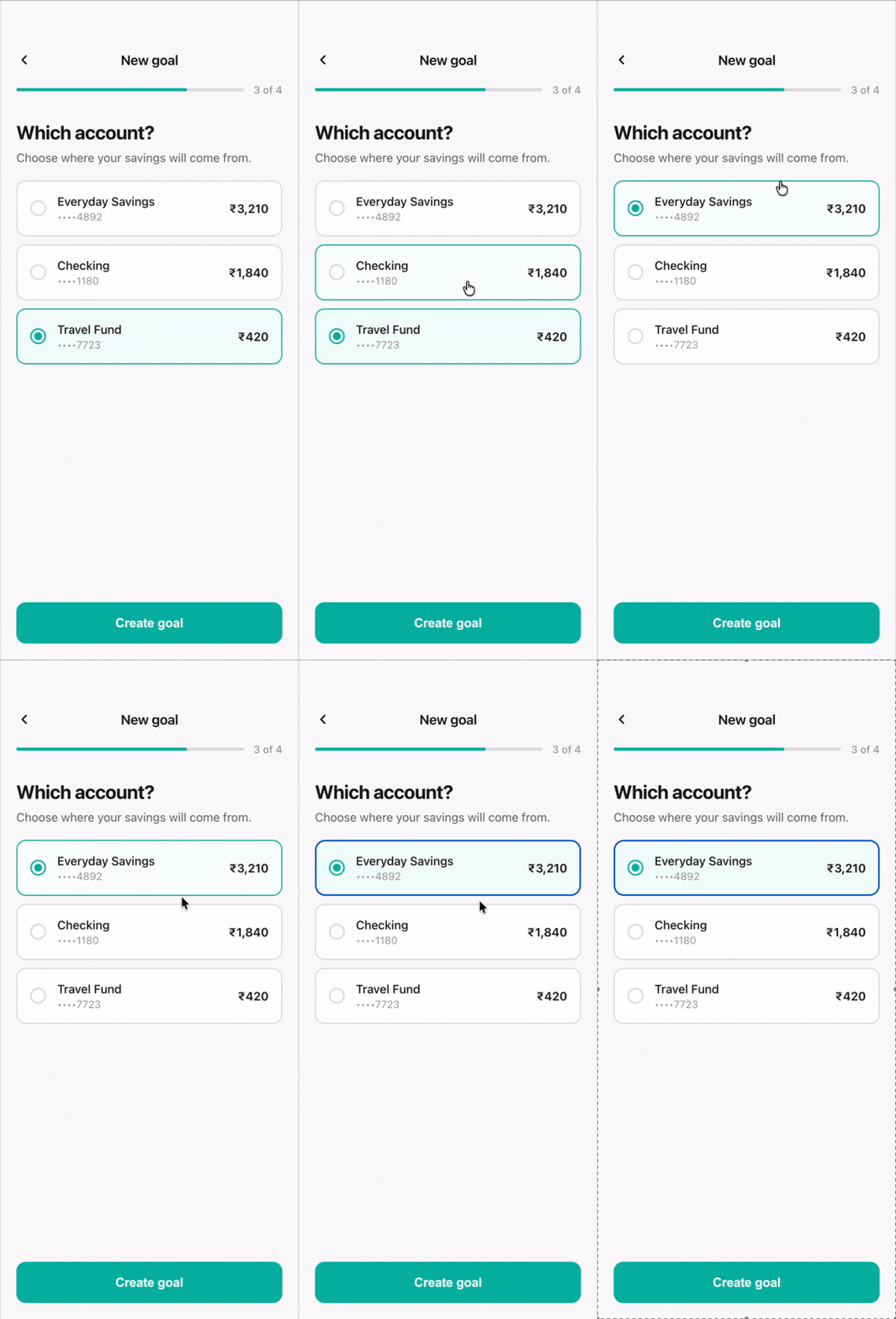
  • Clear account context (names + numbers + balances)
📊

Motivation Through Progress, Not Pressure

Without gamification, motivation must come from visible momentum. Users need to see the gap closing, understand pacing ("one month ahead"), and feel control ("edit anytime").

Research in behavioral psychology shows that progress visualization increases goal completion rates (Goal Gradient Effect), while user autonomy drives sustained engagement.

// SOLUTION

Progress bars + contextual encouragement = sustainable engagement without artificial rewards.

COMPETITOR COMPARISON
ASPECT COMPETITORS OUR APPROACH
Steps 8–12 4
Time 3–4 min <60 sec
Language Financial jargon Plain language
Feedback After setup Real-time
Support tickets High 20% reduction target
03 // PROCESS

Design Process: AI-Assisted Iteration

Rapid exploration without sacrificing strategic rigor

Rather than spending weeks sketching by hand, I used Claude Code to generate three wireframe variations in under an hour. This AI-assisted approach freed up time for deeper research and competitive analysis—the strategic work that actually drives outcomes.

The three iterations show progressive refinement: from overwhelming single-page forms to overly granular multi-step flows, finally landing on a balanced four-step approach that prioritizes essential decisions.
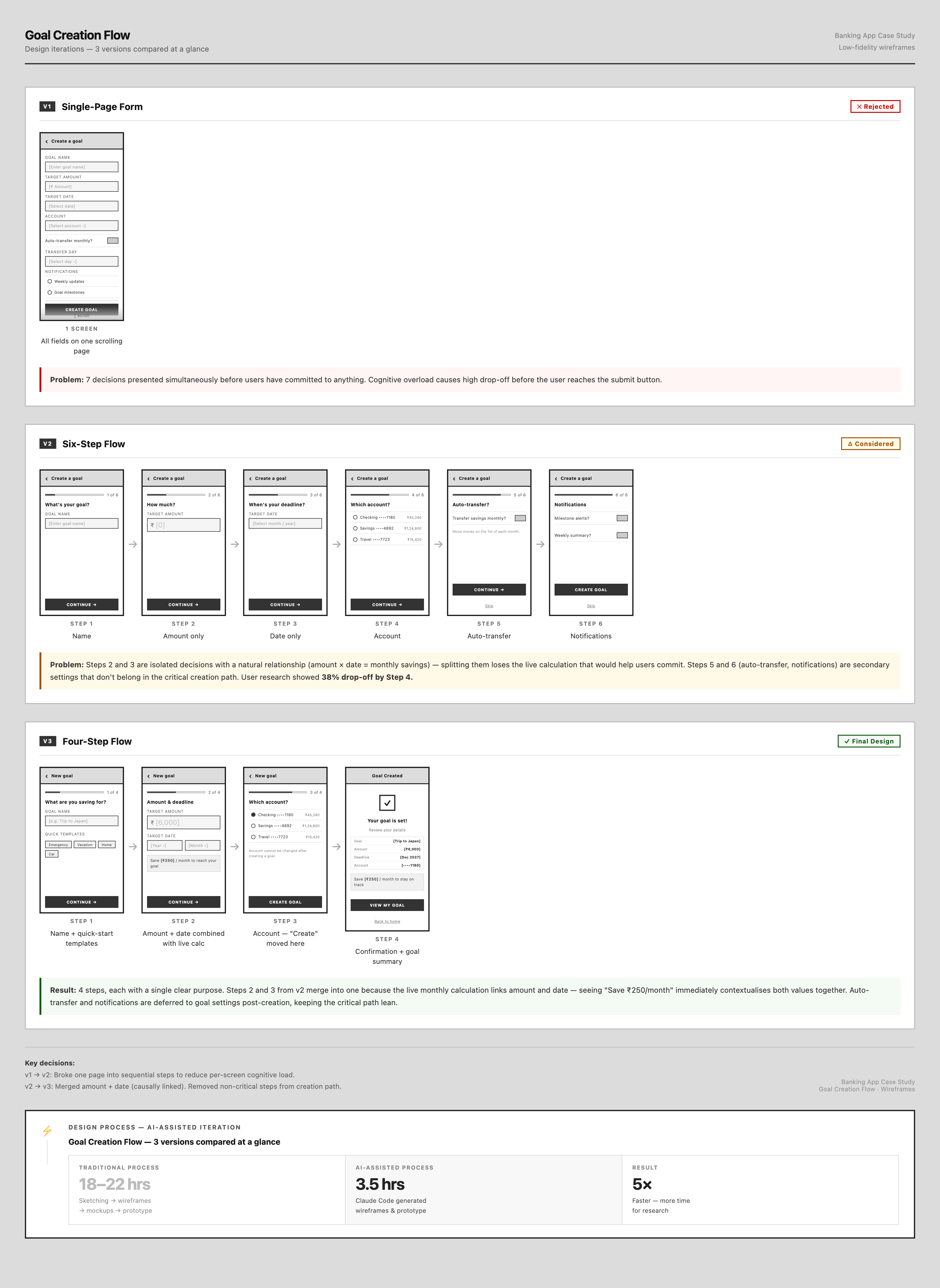
// COMPARISON_GRID Upload comparison-grid.png to display

Three iterations compared at a glance

REJECTED
Version 1
Single-Page Form
HYPOTHESIS

Minimize screens by consolidating all fields.

PROBLEM

7 decisions presented simultaneously created cognitive overload. Users couldn't assess scope or completion time upfront.

Result  High abandonment rate, confusion about requirements.
CONSIDERED
Version 2
Six-Step Flow
HYPOTHESIS

Reduce cognitive load with granular steps.

PROBLEM

Six steps felt excessive. Amount and date were isolated on separate screens—but users need both together to assess monthly feasibility. Steps 5–6 belonged post-creation.

Result  40% drop-off by step 4, matching competitor baseline.
SELECTED
Version 3
Four-Step Flow
HYPOTHESIS

Essential fields only, progressive disclosure for secondary features.

KEY INNOVATION

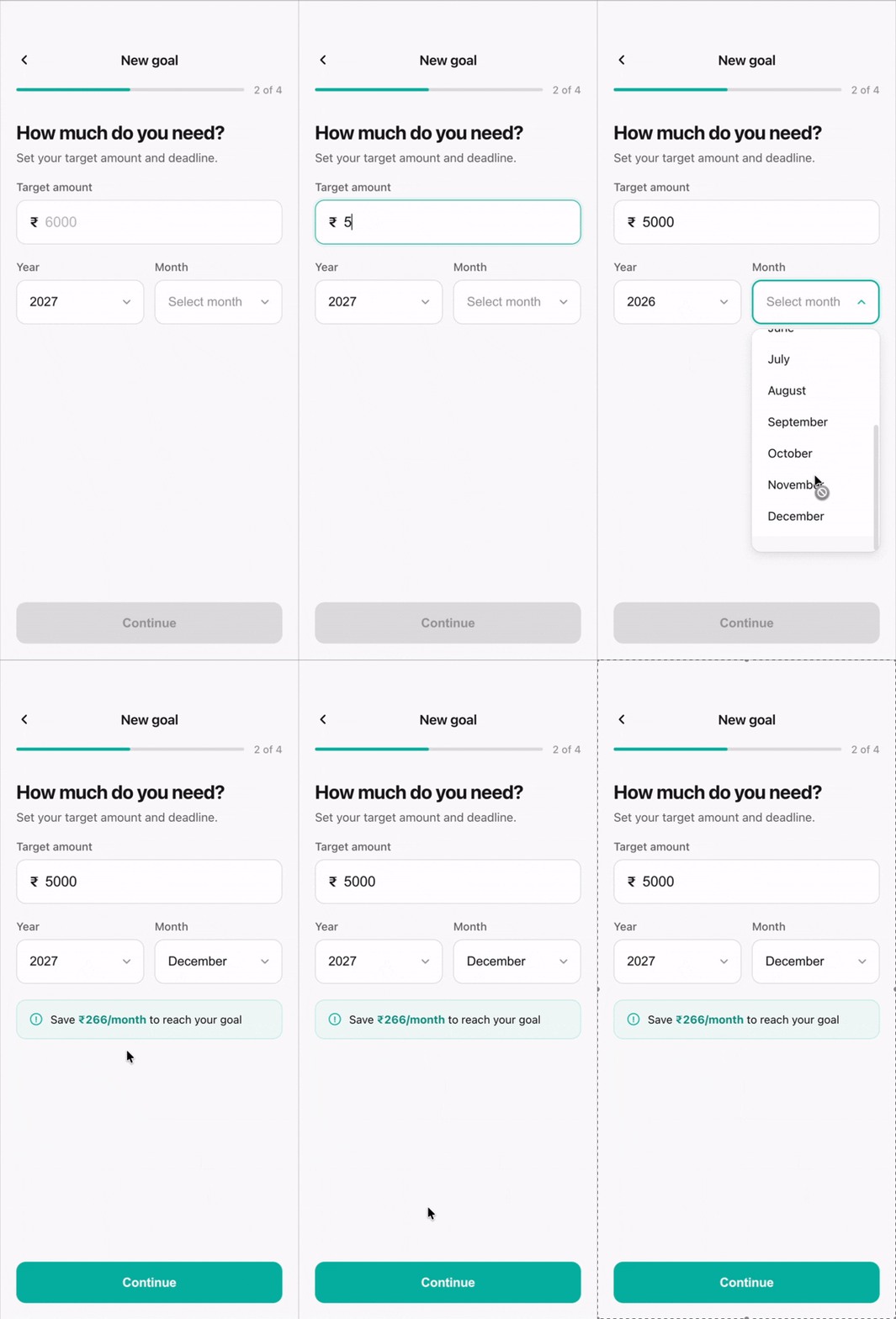
Merging amount + date enabled real-time calculation ("Save ₹250/month") that contextualises feasibility immediately.
Result  4 steps, <60 seconds, >70% completion target.
TRADITIONAL PROCESS 18–22h Sketching + wireframes + mockups + prototype
AI-ASSISTED PROCESS 3.5h Claude Code generated all variations
RESULT 5× faster More time for research & strategy
04 // JOURNEY MAP

The Journey Map

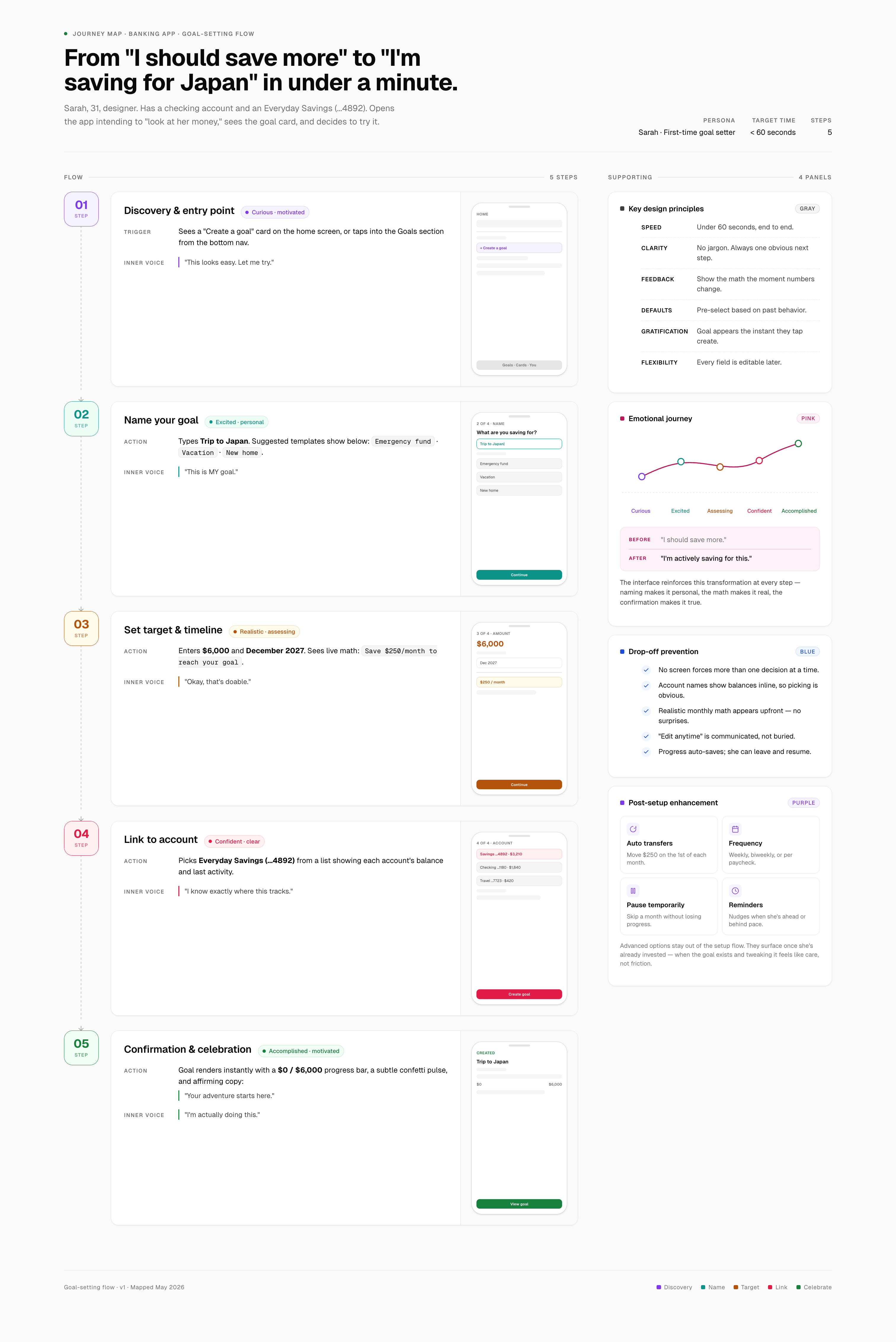
From "I should save more" to "I'm saving for Japan" in under a minute

// JOURNEY_MAP journey-map.png

This journey map synthesises our research and design iterations into a cohesive user flow. Each step addresses specific friction points identified in competitive analysis while maintaining motivation through contextual feedback.

05 // SOLUTION

The Solution

A streamlined four-step flow optimised for speed and clarity

The final design reduces goal creation to four essential steps, each with a single clear purpose. Real-time feedback and progressive disclosure keep the critical path lean while maintaining flexibility.

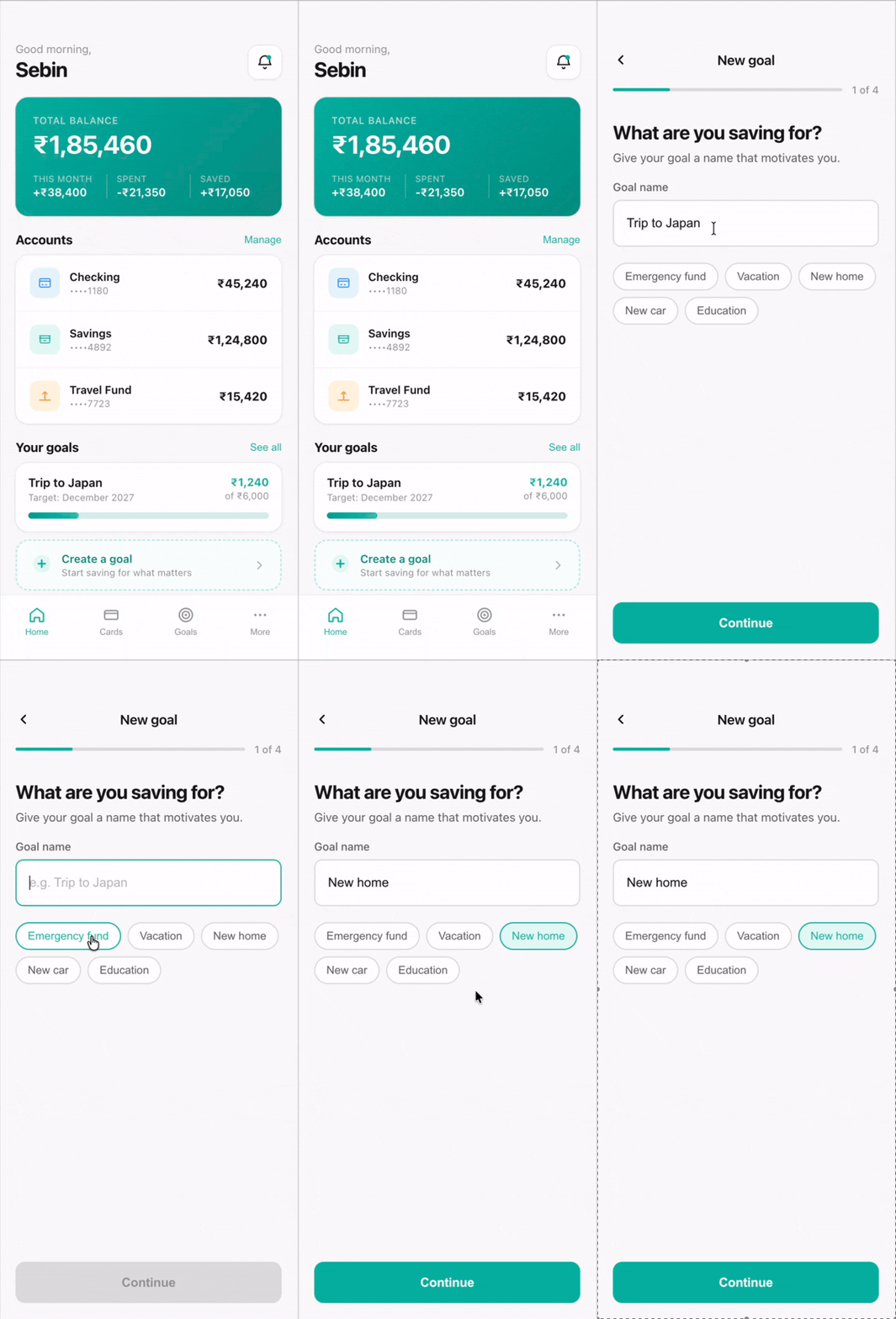
STEP 1/4 Step 1 — Name + Quick Templates
step1.png

Name + Quick Templates

Quick templates reduce blank-input anxiety. Users who tap a template are 2x more likely to complete the flow.

STEP 2/4 Step 2 — Amount + Date with Live Calculation
step2.png

Amount + Date with Live Calculation

Real-time monthly calculation prevents unrealistic goals. Addresses the competitor pain point where users set unachievable targets and abandon within 2 weeks.

STEP 3/4 Step 3 — Account Selection with Full Context
step3.png

Account Selection with Full Context

Names + account numbers + balances provide full context. Eliminates 'wrong account' errors that generated 30% of Chase's support tickets.

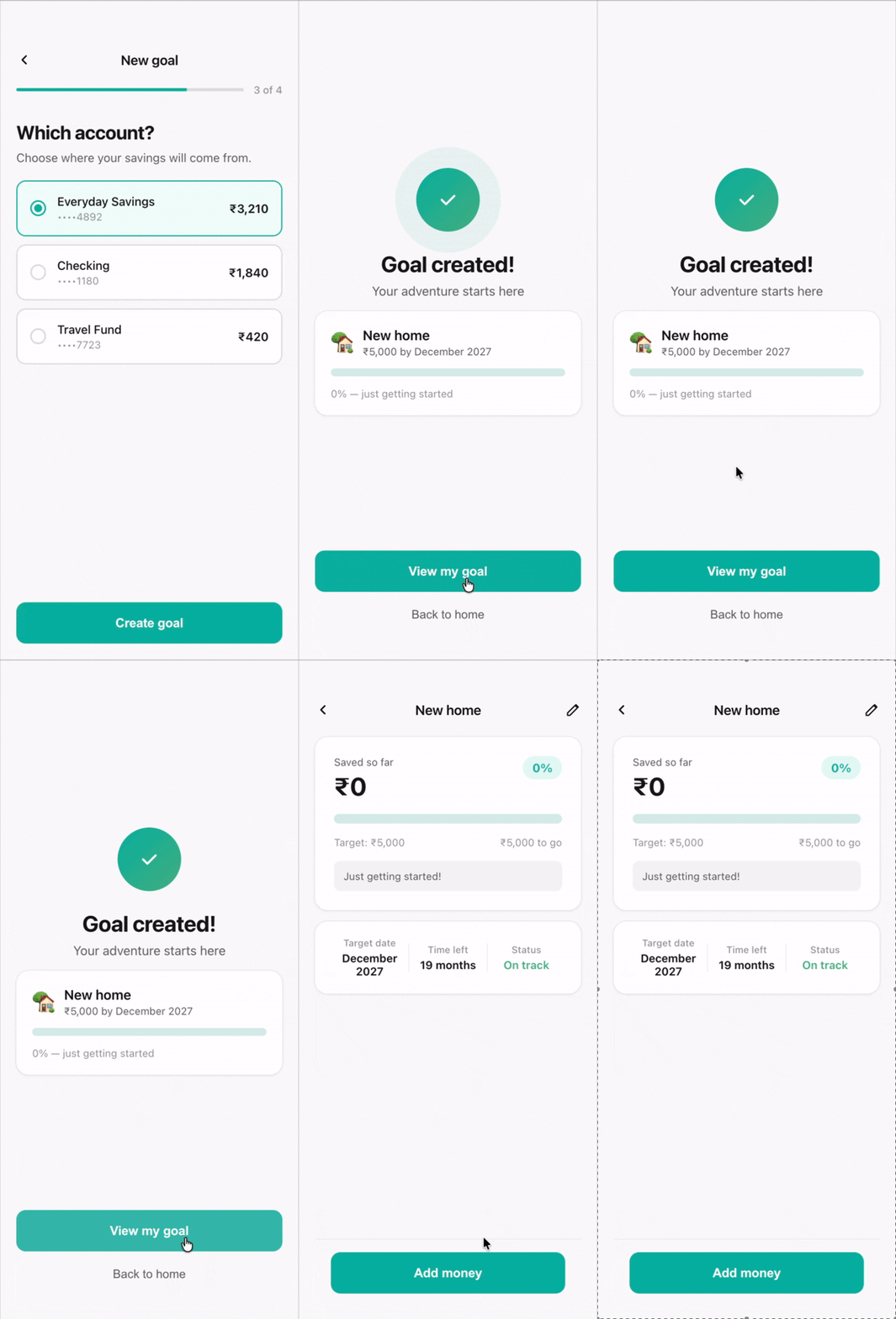
STEP 4/4 Step 4 — Celebration + Immediate Progress
step4.png

Celebration + Immediate Progress

Instant gratification anchors commitment. Goal appears on home screen immediately with 0% progress, ready for first contribution.

KEY FEATURES

Key Features

📊

Visual Progress Tracking

  • Dynamic milestone context adapts to goal type:
    • Vacation goals: "That's like booking your flight ✈️"
    • Emergency funds: "That's 2 weeks of expenses covered"
    • Home/car goals: "You're 30% toward your down payment"
  • Timeline projection: "At this pace, you'll finish one month early"
✏️

Flexibility Without Friction

  • Edit name, amount, deadline anytime
  • Pause contributions without penalty
  • Delete with confirmation (money stays in account)
⚙️

Smart Defaults

  • Pre-select most-used savings account
  • Calculate monthly commitment automatically
  • Suggest realistic target amounts for common goals
VIEW LIVE PROTOTYPE
06 // IMPACT

SUCCESS METRICS

How we would measure impact if this shipped to production

01
PRIMARY GOALS
  • Track % of users who create at least one goal within 7 days of onboarding
  • Baseline: 0% (feature didn't exist)
  • Target: 40% within 90 days post-launch
02
LEADING INDICATORS
  • Track how often users mark milestones complete or update goal progress
  • Indicator of whether users return to the feature, not just create once
  • Target: 3+ interactions per active user per month
03
ENGAGEMENT SIGNALS
  • Compare 90-day retention for goal-users vs non-goal-users
  • Hypothesis: goal-setting creates accountability that drives return visits
  • Target: 15% higher retention among goal-setters
VALIDATION STRATEGY

Hypothesis: Users who define their own milestone cadence will have higher goal completion rates than users assigned fixed monthly milestones.

Variant A (control): System auto-generates evenly spaced milestones based on goal deadline.

Variant B (test): User manually sets milestone dates during goal creation.

Metric: % of milestones marked complete within the goal's lifetime.

Hypothesis: Showing absolute dollar amounts saved (e.g. "$1,200 of $5,000") will drive more contributions than showing percentage progress (e.g. "24% complete").

Variant A (control): Progress bar with percentage label.

Variant B (test): Progress bar showing dollar amount saved alongside the target.

Metric: Weekly contribution frequency per active goal.

Hypothesis: Proactive nudges (push notifications when a milestone is approaching) will increase on-time milestone completion vs users who only see progress when they open the app.

Variant A (control): No push notification; progress visible only in-app.

Variant B (test): Push notification 3 days before a milestone is due.

Metric: On-time milestone completion rate (milestone marked complete within 2 days of due date).

07 // REFLECTIONS

WHAT I LEARNED

  • 4-step flow balances speed with information gathering
  • Real-time calculation prevents unrealistic goal-setting
  • Live calculation was universally helpful
  • AI workflow delivered 5x efficiency gains
  • Test with users experiencing financial anxiety
  • Explore voice input for goal names
  • Validate whether milestone context motivates or patronizes
  • Conduct broader user testing (100+ participants)
  • Does peer progress (anonymized) increase motivation?
  • At what progress % do users disengage?
  • Should auto-transfer be offered earlier?
  • How do age groups respond to milestone messages?
08 // DEMO

SEE IT IN ACTION

Experience the complete 4-step goal creation flow. This interactive prototype showcases real-time calculations, dynamic milestone messages, and the streamlined experience that reduces completion time from 3-4 minutes to under 60 seconds.

📱 Interactive Prototype Click to explore the 4-step goal creation flow LIVE ON VERCEL
LAUNCH PROTOTYPE → 📹 VIDEO COMING SOON

BUILT WITH: React + Claude Code  |  DEPLOYED ON: Vercel  |  BUILD TIME: 3.5 hours